Blue-Flowered Torch
Tillandsia lindenii
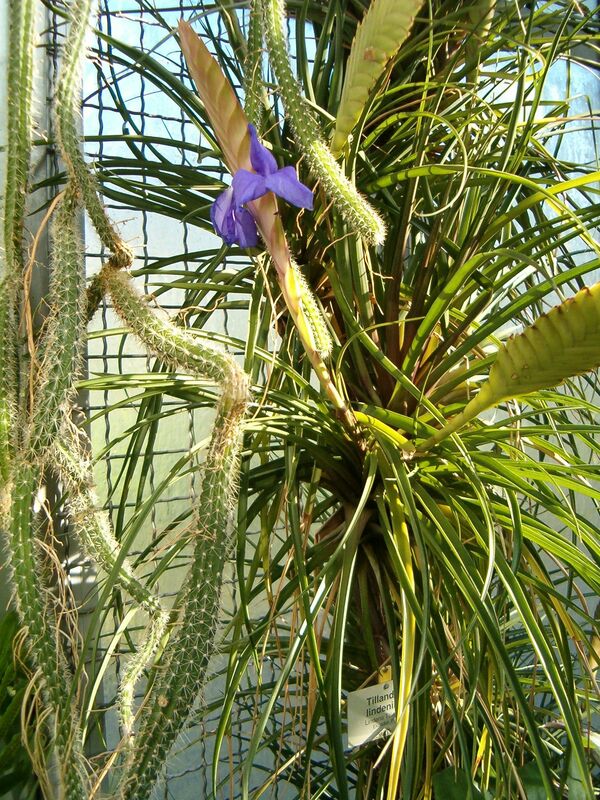
Tillandsia lindenii is an epiphytic bromeliad that grows without soil, anchoring itself to trees and absorbing moisture through specialized leaf cells called trichomes. Its most dramatic feature is a flat, paddle-shaped pink bract up to 20 cm long, from which deep purple-blue, white-eyed flowers emerge one at a time over a period of several months. After the flower fades, the parent rosette dies back but produces offsets at the base so your plant lives on.
How to grow Blue-Flowered Torch
bright indirect light (3-6 feet
Mist leaves 2-3 times per
60-70%
18-28°C
If potted rather than mounted,
Remove offsets (pups) that form
Susceptible to Fusarium rot if
Fun Facts
Tillandsia lindenii uses CAM photosynthesis — the same water-saving strategy as cacti — keeping its leaf pores closed during the day and opening them only at night to reduce water loss.
Pet safe
Non-toxic to humans, cats, and dogs. The leaves may have small spines that cause physical irritation, and loose leaf segments can be a choking hazard to small pets.
Sources
- Tillandsia lindenii | RHS (opens in new tab)Botanical Garden
- Tillandsia lindenii | RHS (opens in new tab)Botanical Garden
- Pink Quill / Blue Flowered Torch Care Guide | Our House Plants (opens in new tab)Reference
- Pink Quill / Blue Flowered Torch Care Guide | Our House Plants (opens in new tab)Reference
- Tillandsia lindenii | Llifle Encyclopedia of Bromeliads (opens in new tab)Reference
- Tillandsia lindenii | Llifle Encyclopedia of Bromeliads (opens in new tab)Reference
- Wallisia lindenii (formerly Tillandsia) | Tropiflora (opens in new tab)Reference
- Wallisia lindenii (formerly Tillandsia) | Tropiflora (opens in new tab)Reference