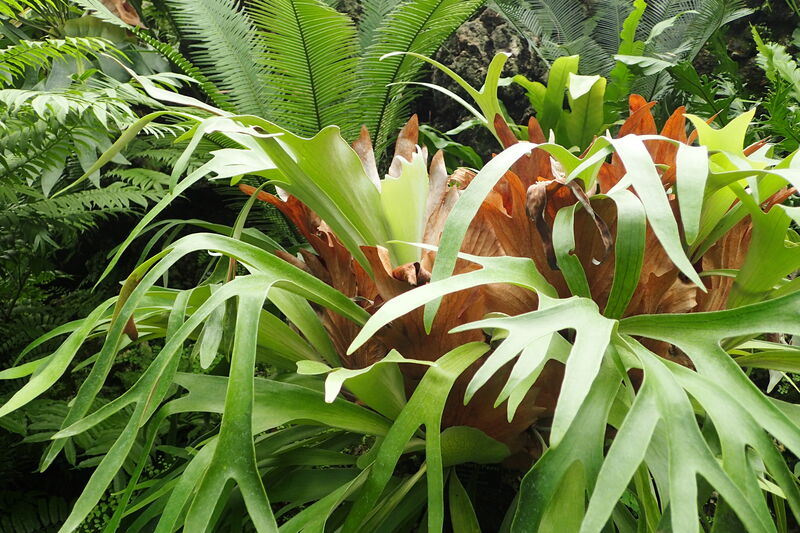
Staghorn Fern
Platycerium bifurcatum
Staghorn Ferns are the houseplant world's best argument for hanging something on a wall — mounted on a wooden plaque with a pad of sphagnum moss, they look more like living sculpture than a plant. Your fern produces two distinct frond types: flat, brown shield fronds that anchor it to its mount, and the dramatic, forked, antler-shaped green fronds that give it its name. It's non-toxic to pets and people, and it received the RHS Award of Garden Merit in 1993.
How to grow Staghorn Fern
Bright, indirect light, similar to
Soak the mounting medium thoroughly
60-80%
Above 55°F as a general rule, though P.
Not grown in soil.
Most reliably by division: carefully
Scale insects and mealybugs are
Fun Facts
The brown, shield-shaped basal fronds look dead but are doing important work — they anchor the plant, protect the roots, and collect falling debris that breaks down into nutrients. Removing them will harm or kill the plant.
Pet safe
Non-toxic to dogs, cats, and horses (ASPCA confirmed).
Sources
- Common Staghorn Fern - ASPCA Toxic and Non-Toxic Plants (opens in new tab)Reference
- Common Staghorn Fern — ASPCA Toxic and Non-Toxic Plants (opens in new tab)Reference
- Platycerium bifurcatum - NC State Extension Gardener Plant Toolbox (opens in new tab)University Extension
- Platycerium bifurcatum — NC State Extension Gardener Plant Toolbox (opens in new tab)University Extension
- Staghorn Fern - University of Florida IFAS Gardening Solutions (opens in new tab)University Extension
- Staghorn Fern — University of Florida IFAS Gardening Solutions (opens in new tab)University Extension
- Staghorn Fern, Platycerium bifurcatum - Wisconsin Horticulture, UW Extension (opens in new tab)University Extension
- Staghorn Fern, Platycerium bifurcatum — Wisconsin Horticulture, UW Extension (opens in new tab)University Extension