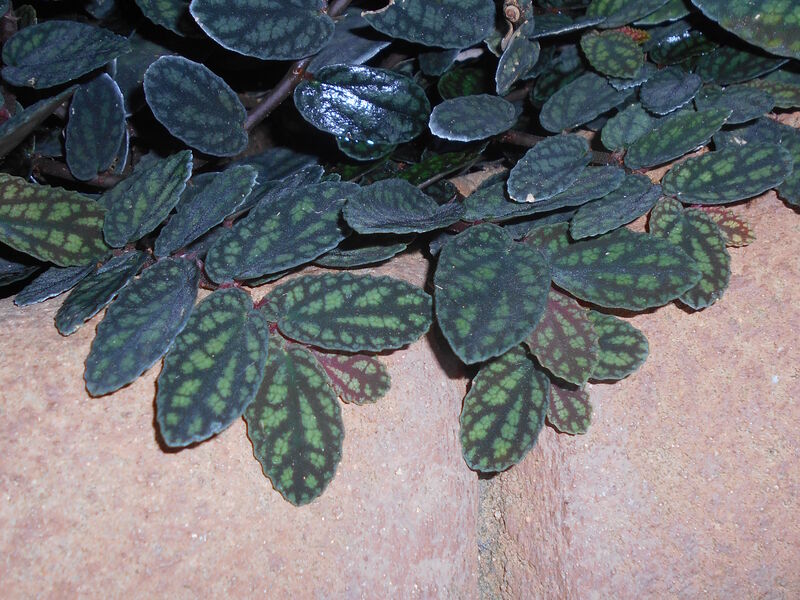
Satin Pellionia
Pellionia pulchra
Satin Pellionia earns its name honestly — the oval leaves display an almost metallic satin sheen, with dark, near-black veins weaving through a silvery gray-green surface and deep purple undersides that flash when the trailing stems move. Your plant grows as a low, spreading creeper that's ideal for hanging baskets, shelves where stems can trail, or terrariums where the high humidity will make it very happy. It's a member of the nettle family but carries none of the sting — just the looks.
How to grow Satin Pellionia
Medium to bright indirect light
Keep the soil lightly and
70%
Thrives between 65°F and 80°F (18 to 26°C).
Light, airy, moisture-retaining mix: a
Stem cuttings root very easily
Root rot from overwatering in
Fun Facts
The genus Pellionia was named after A.M.J. Alphonse Pellio (1795 to 1868), a French naval officer and artist who served as a draughtsman on a scientific voyage around the world in the early 19th century — so this plant carries a small piece of maritime exploration history in its name.
Pet safe
Non-toxic to cats, dogs, and humans according to the ASPCA.
Sources
- Our Best Guide for Pellionia - UK Houseplants (opens in new tab)Reference
- Our Best Guide for Pellionia - UK Houseplants (opens in new tab)Reference
- Pellionia Pulchra Care: How To Grow Polynesian Ivy Indoors (opens in new tab)Reference
- Pellionia Pulchra Care: How To Grow Polynesian Ivy Indoors (opens in new tab)Reference
- Pellionia pulchra (Satin Pellionia) - Top Tropicals Plant Encyclopedia (opens in new tab)Reference
- Pellionia pulchra (Satin Pellionia) - Top Tropicals Plant Encyclopedia (opens in new tab)Reference
- Pellionia pulchra - Little Prince of Oregon Nursery (opens in new tab)Reference
- Pellionia pulchra - Little Prince of Oregon Nursery (opens in new tab)Reference
- Satin Pellionia (Pellionia pulchra) Care, Pruning, Propagation (opens in new tab)Reference
- Satin Pellionia (Pellionia pulchra) Care, Pruning, Propagation (opens in new tab)Reference