Irish Mittens
Opuntia vulgaris
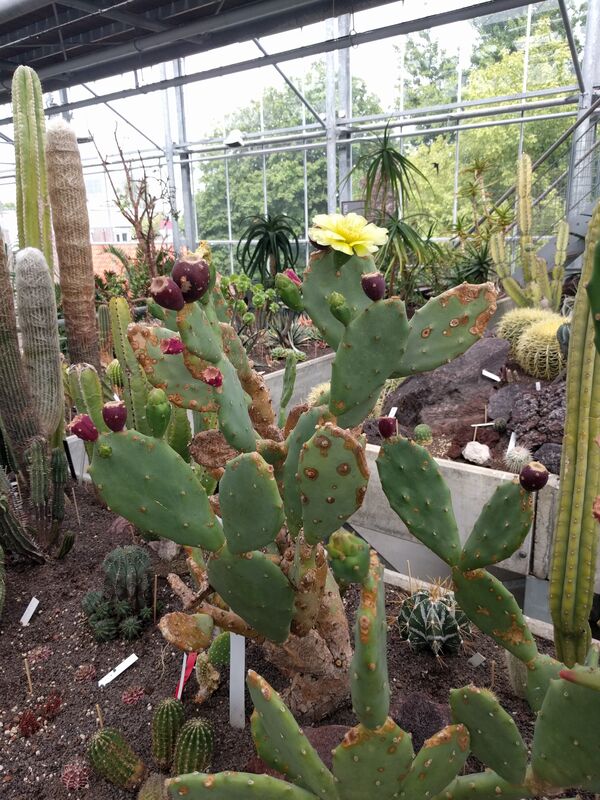
Irish Mittens is a shrubby to tree-like cactus with glossy bright-green, broadly ovate paddle segments and relatively few spines compared to many Opuntia relatives. In summer it produces showy yellow flowers with red flushes, followed by deep red spherical fruit. The popular variegated cultivar 'Joseph's Coat' adds cream and pink splashes to the pads, making it genuinely decorative even when not in bloom. Note that Opuntia vulgaris is a widely used name but the currently accepted botanical name is Opuntia monacantha.
How to grow Irish Mittens
full sun (6 or more
In the growing season, water
Prefers dry conditions.
Ideal range is 68-100 degrees
70-80%
Take a stem segment (pad)
Root rot is the main cause of death.
Fun Facts
Opuntia vulgaris (Opuntia monacantha) has become one of the most widely naturalized cacti on the planet -- introduced to South Africa, India, Sri Lanka, Southeast Asia, and Australia, where it is considered a serious invasive weed and subject to biological control programs.
Pet safe
Non-toxic to dogs, cats, and humans -- the pads and fruit are edible. The spines and glochids cause physical injury but are not chemically toxic.
Sources
- Opuntia Species, Joseph's Coat, Irish Mittens - Dave's Garden (opens in new tab)Reference
- Opuntia Species, Joseph's Coat, Irish Mittens - Dave's Garden (opens in new tab)Reference
- Opuntia monacantha (Drooping Prickly Pear / Irish Mittens) - Shoot Gardening (opens in new tab)Reference
- Opuntia monacantha (Drooping Prickly Pear / Irish Mittens) - Shoot Gardening (opens in new tab)Reference
- Opuntia monacantha (Drooping Prickly Pear) - World of Succulents (opens in new tab)Reference
- Opuntia monacantha (Drooping Prickly Pear) - World of Succulents (opens in new tab)Reference
- Opuntia monacantha - CABI Invasive Species Compendium (opens in new tab)Reference
- Prickly Pear Cactus - Opuntia Monacantha Care Guide - JOMO Studio (opens in new tab)Reference
- Prickly Pear Cactus - Opuntia Monacantha Care Guide - JOMO Studio (opens in new tab)Reference
- Opuntia monacantha - CABI Invasive Species Compendium (opens in new tab)Peer-Reviewed