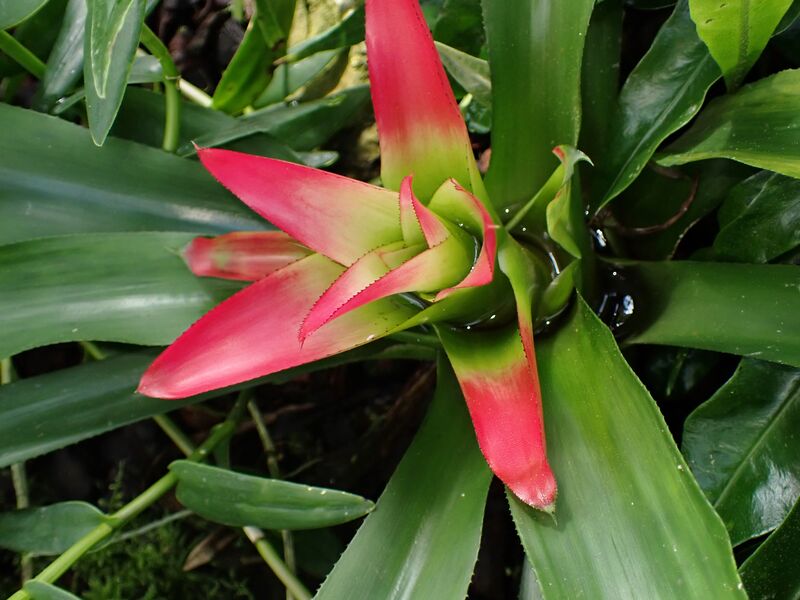
Miniature Bird’s Nest
Nidularium innocentii
Your Nidularium innocentii forms a flat, ground-hugging rosette of strap-shaped leaves about 10 inches long, dark green on top and striking dark red on the undersides. When it is ready to bloom, the short inner leaves turn vivid red, forming a nest-like cup that cradles small white tubular flowers -- which is exactly how it got both its common name (from the Latin 'nidus,' meaning nest) and its place in a lot of living rooms. It is one of the few bromeliads that genuinely thrives in lower light.
How to grow Miniature Bird’s Nest
Bright filtered light (behind a
Fill the central cup with
60-70%
64-77 degrees F (18-25 C)
A light, well-draining mix combining
Separate pups from the mother
Root rot from waterlogged soil
Fun Facts
The central red nest that appears before flowering is not the flower itself -- it is a cluster of brightly colored bracts (modified leaves) surrounding the much smaller white tubular flowers. The bracts can remain visually striking for several months even after the actual flowers have finished.
Pet safe
Non-toxic to cats, dogs, and humans. No harmful compounds have been identified in this species.
Sources
- Nidularium innocentii - Bird's Nest Bromeliad - Royal Horticultural Society (opens in new tab)Botanical Garden
- Bird's Nest Bromeliads (Nidularium Bromeliads) Care Indoors - Home Plants Guide (opens in new tab)Reference
- Bird's Nest Bromeliads (Nidularium Bromeliads) Care Indoors - Home Plants Guide (opens in new tab)Reference
- How to Grow Nidularium - Harvest to Table (opens in new tab)Reference
- How to Grow Nidularium - Harvest to Table (opens in new tab)Reference
- Nidularium innocentii - Bird's Nest Bromeliad - Royal Horticultural Society (opens in new tab)Reference
- Nidularium innocentii - Wikipedia (opens in new tab)Reference
- Nidularium innocentii - Wikipedia (opens in new tab)Peer-Reviewed