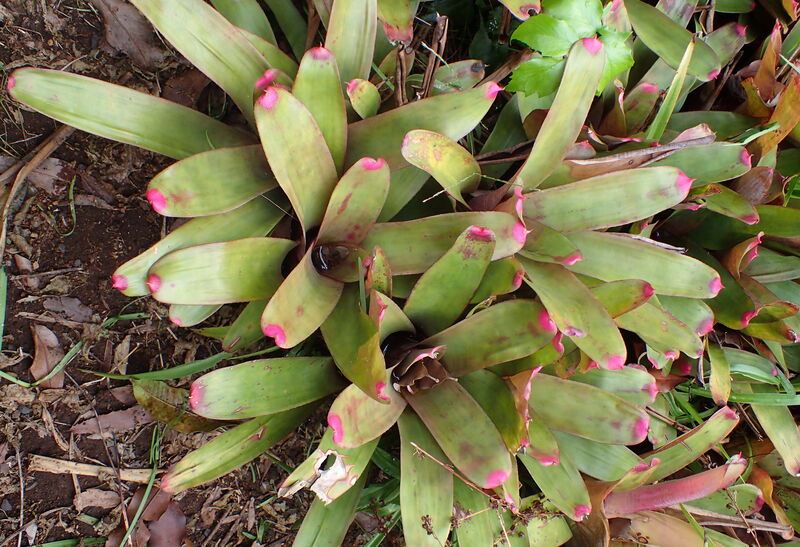
Fingernail Plant
Neoregelia spectabilis
Your Fingernail Plant earns its name from the vivid red-pink tips on each olive-green leaf -- like freshly painted fingernails on a rosette of about 30 strap-shaped leaves. The inner leaves take on maroon and purple tones, while small blue flowers nestle inside the central cup. It forms large clumps over time by producing generous numbers of offsets, so in a warm climate it makes a surprisingly effective groundcover.
How to grow Fingernail Plant
Bright filtered light (behind a
Fill the central cup and
50-70%
60-80 degrees F (15-27 C) is comfortable.
Well-drained, slightly acidic mix around pH 6.
Separate offsets (pups) once they
Root rot from overwatering is
Fun Facts
The species name 'spectabilis' is Latin for 'showy' or 'spectacular' -- a rare case where a plant's scientific name is basically just botanists agreeing with everyone who has ever seen it.
Pet safe
Non-toxic to dogs, cats, and horses. The non-sharp leaf margins also make this a safer bromeliad around bare feet and children compared to many others in the family.
Sources
- Fingernail Plant - Port St. Lucie Botanical Gardens (opens in new tab)Botanical Garden
- Fingernail Plant (Neoregelia spectabilis) - iNaturalist (opens in new tab)Reference
- Fingernail Plant - Port St. Lucie Botanical Gardens (opens in new tab)Reference
- Neoregelia (Blushing Bromeliad, Bromeliad) - NC State Extension Gardener Plant Toolbox (opens in new tab)Reference
- Neoregelia spectabilis - University of Florida IFAS Extension (opens in new tab)Reference
- Fingernail Plant (Neoregelia spectabilis) - iNaturalist (opens in new tab)Peer-Reviewed
- Neoregelia (Blushing Bromeliad, Bromeliad) - NC State Extension Gardener Plant Toolbox (opens in new tab)University Extension
- Neoregelia spectabilis - University of Florida IFAS Extension (opens in new tab)University Extension