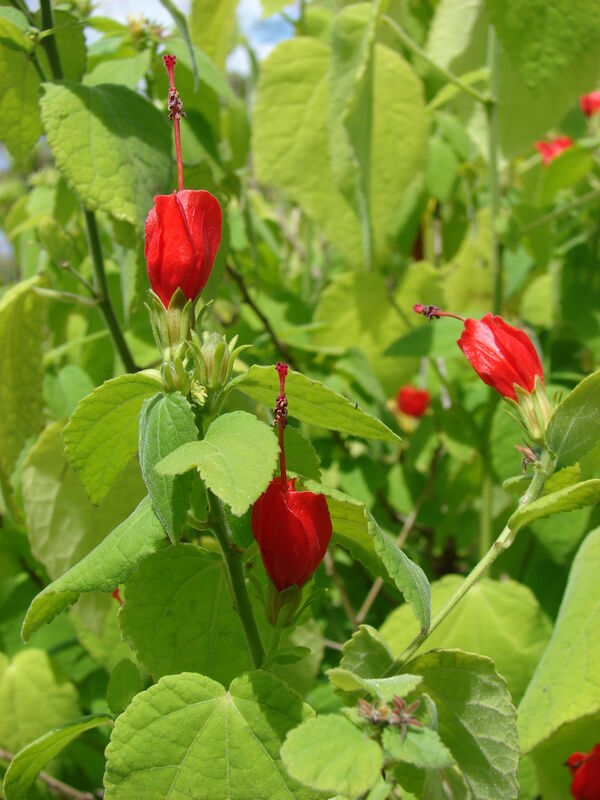
Turk’s Cap
Malvaviscus arboreus
Malvaviscus arboreus is a spreading shrub with hibiscus-like flowers that never quite open -- the bright red petals stay rolled into a loose tube with the staminal column poking out, which is exactly what a Turkish turban looks like and exactly how it got its name. It thrives in shady spots where most flowering shrubs would sulk, making it the rare garden plant that genuinely prefers the spot under the oak tree. You can also eat the small apple-flavored fruits, which is a bonus that most ornamentals cannot claim.
How to grow Turk’s Cap
part shade (2-4 hours of
drought tolerant (can go 2-3
Tolerates a wide range of humidity.
Hardy in USDA zones 7-11.
Adaptable to sandy, loamy, clay,
Softwood cuttings 4-6 inches long
Very few.
Fun Facts
The small red fruits taste like mild apple, which is why the plant is called 'Manzanilla' (Little Apple) in Spanish -- you can eat them raw or cooked.
Pet safe
Non-toxic to pets and humans. The fruits, flowers, and leaves are edible. Scientific research has confirmed no acute toxicity.
Sources
- Malvaviscus arboreus (Turkscap) | Lady Bird Johnson Wildflower Center (opens in new tab)Botanical Garden
- Malvaviscus arboreus (Turkscap) | Lady Bird Johnson Wildflower Center (opens in new tab)Reference
- Malvaviscus arboreus - Wikipedia (opens in new tab)Reference
- Malvaviscus arboreus - Wikipedia (opens in new tab)Reference
- Turk's Cap - My Favorite Native | Texas Master Gardeners (opens in new tab)Reference
- Turk's Cap - My Favorite Native | Texas Master Gardeners (opens in new tab)Reference