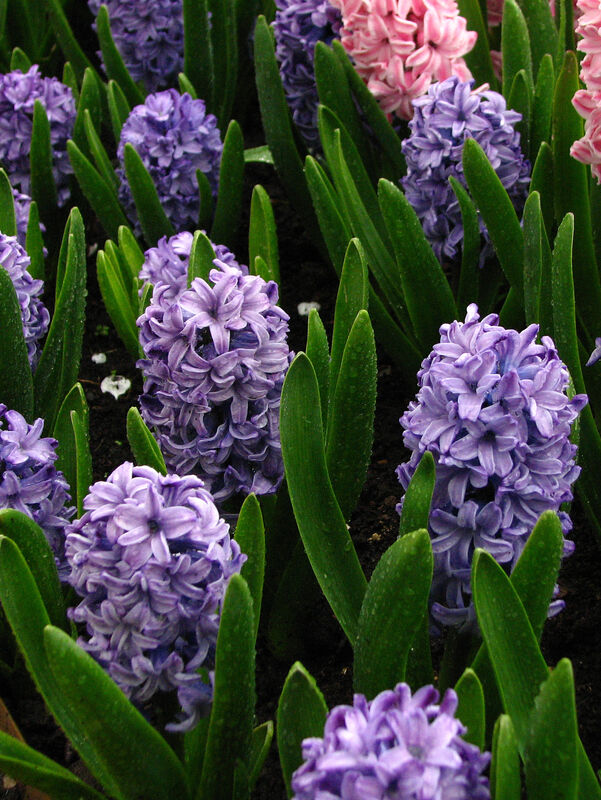
Hyacinth
Hyacinthus orientalis
The Hyacinth is one of spring's most recognizable plants, packing a dense spike of bell-shaped flowers in shades from deep violet to coral pink to pure white, all wrapped in a fragrance strong enough to fill an entire room. You can force the bulbs to bloom indoors in winter by giving them a cold stratification period, making them a popular choice for brightening up January and February when everything else is still dormant.
How to grow Hyacinth
full sun (6 or more
keep moist (water when the
30-50%
50-65°F
Rich, organically amended, well-draining soil
Division of offsets after the
Bulb rot in wet or
Fun Facts
The hyacinth's name traces back to Greek mythology: Hyacinthus was a Spartan youth beloved by the god Apollo, who was accidentally killed by a discus. Apollo transformed him into a flower in grief, and it is said the Greek letters 'AI AI' (an expression of mourning) appear on the petals.
Toxic to pets
Toxic to dogs, cats, and horses according to ASPCA. All parts contain alkaloids and calcium oxalate crystals, with the bulb being the most concentrated source. Can cause vomiting, diarrhea, and in severe cases tremors. Causes contact dermatitis on skin -- gloves recommended when handling bulbs.
Sources
- Toxic and Non-toxic Plants: Hyacinth -- ASPCA (opens in new tab)ASPCA
- Toxic and Non-toxic Plants: Hyacinth -- ASPCA (opens in new tab)ASPCA
- Hyacinth Care: A Guide to Growing Hyacinthus Orientalis Indoors -- Our Houseplants (opens in new tab)Reference
- Hyacinth Care: A Guide to Growing Hyacinthus Orientalis Indoors -- Our Houseplants (opens in new tab)Reference
- Common Hyacinth -- UC ANR Solano County (opens in new tab)University Extension
- Common Hyacinth -- UC ANR Solano County (opens in new tab)University Extension
- Hyacinthus orientalis -- NC State Extension Gardener Plant Toolbox (opens in new tab)University Extension
- Hyacinthus orientalis -- NC State Extension Gardener Plant Toolbox (opens in new tab)University Extension