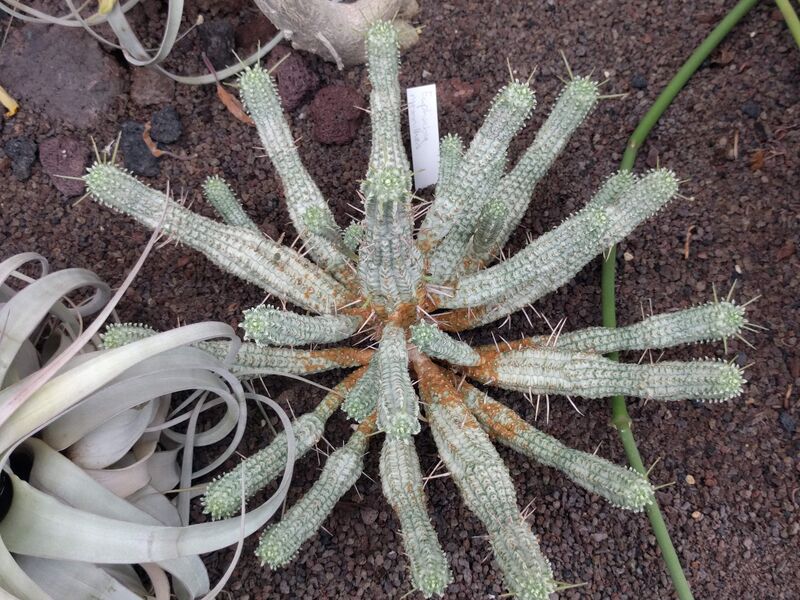
Corncob Cactus
Euphorbia mammillaris
Euphorbia mammillaris is a column-forming succulent with thick, chalky gray-green stems covered in dense rows of hexagonal, knobby tubercles that really do look startlingly like a cob of corn, right down to the arrangement of the 'kernels' in neat vertical rows. Your plant is not a true cactus despite the common name, but it is drought-tolerant and just as easy to kill with overwatering as any cactus. In late winter through early summer it produces small yellow flowers clustered at the tips of each stem, which are easy to miss but add a nice seasonal touch.
How to grow Corncob Cactus
full sun (6 or more
Water weekly in summer, allowing
Tolerates average household humidity without
Thrives in warm temperatures (70-85F
Well-draining cactus or succulent soil
Stem cuttings in spring or summer.
Mealybugs and spider mites.
Fun Facts
Despite the common name, Euphorbia mammillaris is not a cactus at all; it is a member of the Euphorbiaceae family, which also includes poinsettias, rubber trees, and cassava. The cactus-like appearance is a case of convergent evolution — two entirely different plant families arriving at the same spiny, succulent body plan as a response to the same dry, sunny conditions.
Toxic to pets
Toxic. The milky latex sap contains diterpene esters that cause skin irritation, eye damage on contact, and oral and gastrointestinal blistering if ingested. The NCSU Extension rates the severity as low for typical contact but warns of potential corneal damage from eye exposure. Keep away from children and pets; always wear gloves when handling.
Sources
- Euphorbia Mammillaris (Indian Corn Cob) - Succulent City (opens in new tab)Reference
- Euphorbia Mammillaris (Indian Corn Cob) - Succulent City (opens in new tab)Reference
- Euphorbia mammillaris - Wikipedia (opens in new tab)Reference
- Euphorbia mammillaris - Wikipedia (opens in new tab)Reference
- How to Care for Corn Cob Cactus - Succulents Box (opens in new tab)Reference
- How to Care for Corn Cob Cactus - Succulents Box (opens in new tab)Reference
- Euphorbia mammillaris - NC State Extension Gardener Plant Toolbox (opens in new tab)University Extension
- Euphorbia mammillaris - NC State Extension Gardener Plant Toolbox (opens in new tab)University Extension