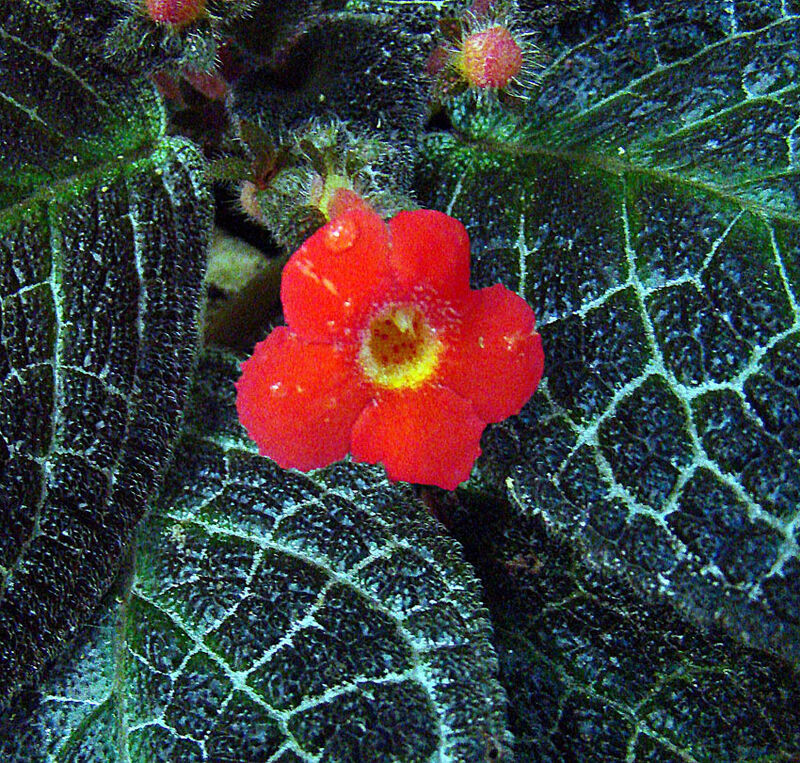
Flame Violet
Episcia cupreata
Episcia cupreata is a low, trailing tropical perennial grown as much for its velvety, metallic-toned foliage as for its vivid red flowers with yellow eyes. The leaves are the real attraction here: oval, up to 4 inches long, and shimmering with coppery, silver, or bronze tones depending on the cultivar you choose. Your plant spreads by producing strawberry-like runners (stolons) that dangle from hanging baskets and root wherever they touch soil, making it an impressively generous self-propagator once it finds conditions it likes.
How to grow Flame Violet
Bright, indirect light; no direct
Keep the soil consistently moist but never soggy.
60-80%
warm temperatures (70-85F / 21-29C)
Loose, well-draining, humus-rich mix.
Extremely easy from stolons (runners).
Spider mites and mealybugs.
Fun Facts
The genus name Episcia comes from the Greek episkios, meaning 'shaded,' which perfectly describes where you find this plant in nature: tucked under the canopy of tropical forest trees in dense, humid shade.
Pet safe
Non-toxic to cats, dogs, and humans, confirmed by the ASPCA.
Sources
- Episcia cupreata | Gesneriad Reference Web (opens in new tab)Botanical Garden
- Gesneriads Turn on the Guiding Light - Smithsonian Plant Press (opens in new tab)Botanical Garden
- Episcia cupreata | Gesneriad Reference Web (opens in new tab)Reference
- Flame Violet (Episcia cupreata) - Gardenia.net (opens in new tab)Reference
- Flame Violet (Episcia cupreata) - Gardenia.net (opens in new tab)Reference
- Gesneriads Turn on the Guiding Light - Smithsonian Plant Press (opens in new tab)Reference
- How to Grow and Care for Episcia - Houseplant 411 (opens in new tab)Reference
- How to Grow and Care for Episcia - Houseplant 411 (opens in new tab)Reference