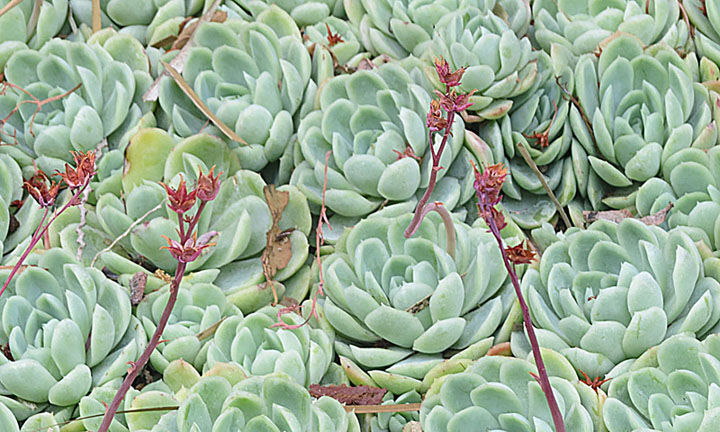
Mexican Snowball
Echeveria elegans
Echeveria elegans forms a tight, symmetrical rosette of pale blue-green, spoon-shaped leaves coated with a white powdery film called farina that gives the whole plant a soft, frosted look — which is exactly why it earned the name Mexican Snowball. Your plant will stay compact and tidy, usually topping out around 4 inches tall, and it will reward you with arching pink flower stalks tipped with coral-yellow bell-shaped blooms from late winter through spring. It also readily produces offsets, so one plant quickly becomes a happy family.
How to grow Mexican Snowball
At least 6 hours of bright light daily.
Allow the soil to dry
50%
Not frost-hardy; keep above freezing.
Well-draining succulent or cactus mix.
Easily propagated from the offsets
Aphids and mealybugs, particularly on
Fun Facts
The powdery coating on the leaves, called farina or epicuticular wax, is a natural UV shield and moisture barrier — try not to touch the leaves, because once that coating is wiped off, it does not grow back.
Pet safe
Non-toxic to cats, dogs, and humans, according to the ASPCA.
Sources
- Echeveria elegans (Mexican Snowball) - World of Succulents (opens in new tab)Reference
- Echeveria elegans (Mexican Snowball) - World of Succulents (opens in new tab)Reference
- Echeveria elegans Mexican Snowball - Planet Desert (opens in new tab)Reference
- Echeveria elegans Mexican Snowball - Planet Desert (opens in new tab)Reference
- How to Care for Echeveria Elegans Mexican Snowball - Succulents Box (opens in new tab)Reference
- How to Care for Echeveria Elegans Mexican Snowball - Succulents Box (opens in new tab)Reference
- Is Echeveria Poisonous to Cats? - Catster (opens in new tab)Reference
- Is Echeveria Poisonous to Cats? - Catster (opens in new tab)Reference