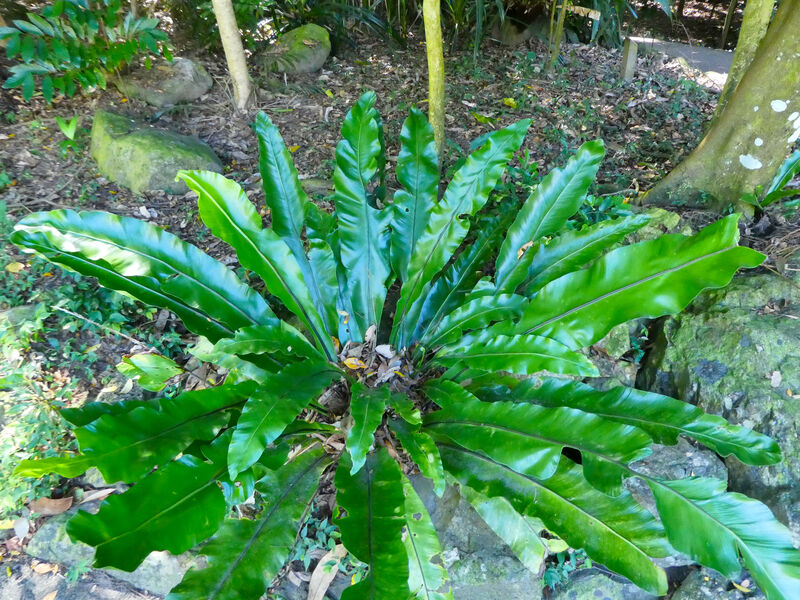
Bird’s Nest Fern
Asplenium nidus
The Bird's Nest Fern stands out from most ferns by growing large, undivided, strap-like fronds -- more banana leaf than typical feathery fern -- that spiral outward from a central rosette resembling, yes, a bird's nest. In the wild it grows as an epiphyte perched in tree branches, catching falling debris to create its own compost. Indoors it is one of the more forgiving ferns you can grow, tolerating lower humidity than most of its relatives.
How to grow Bird’s Nest Fern
bright indirect light (3-6 feet
Water when the top inch
50-80%
60-75°F
Well-draining, moisture-retentive potting mix.
Propagated from spores sown on
Root rot from overwatering or
Fun Facts
In Hawaii, where it is called ekaha, the dark midribs of the fronds were traditionally woven into lau hala mats for pattern and color contrast, and the leaves adorned hula altars.
Pet safe
Non-toxic to cats, dogs, and humans. Fronds are even eaten raw or cooked in parts of Taiwan and New Caledonia.
Sources
- Asplenium nidus - Missouri Botanical Garden Plant Finder (opens in new tab)Botanical Garden
- Bird's-nest Fern - San Diego Zoo (opens in new tab)Botanical Garden
- Asplenium nidus - Missouri Botanical Garden Plant Finder (opens in new tab)Reference
- Asplenium nidus - NC State Extension Gardener Plant Toolbox (opens in new tab)Reference
- Asplenium nidus - Wikipedia (opens in new tab)Reference
- Asplenium nidus - Wikipedia (opens in new tab)Reference
- Bird's-nest Fern - San Diego Zoo (opens in new tab)Reference
- How To Grow and Care for Bird's Nest Fern - Clemson University HGIC (opens in new tab)Reference
- Asplenium nidus - NC State Extension Gardener Plant Toolbox (opens in new tab)University Extension
- How To Grow and Care for Bird's Nest Fern - Clemson University HGIC (opens in new tab)University Extension