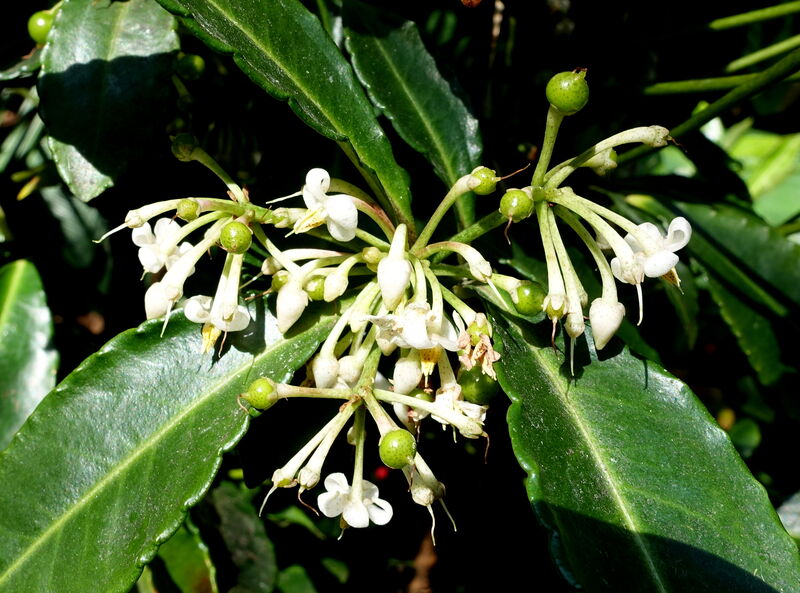
Ardisia
Ardisia crenata
Ardisia crenata is grown almost entirely for its striking clusters of glossy red berries, which appear in late summer and typically hang on through the entire winter. It is a compact evergreen shrub with wavy-edged, dark green leaves that looks sharp year-round and downright festive from October through January. Just be aware that in warm climates it has escaped cultivation and is considered highly invasive.
How to grow Ardisia
bright indirect light (3-6 feet
Keep soil evenly and consistently
50-60%
Prefers cool to average conditions:
Standard, well-draining houseplant potting mix.
84-98%
Sudden berry or flower drop
Fun Facts
Ardisia crenata is classified as a Category I invasive species in Florida, where it was introduced in the early 1900s as an ornamental and has since escaped into hardwood hammocks; the Florida genotype produces up to 631 seedlings per square meter compared to just 5 for native Japanese populations.
Toxic to pets
Mildly toxic to humans, dogs, and cats. Berries and leaves contain saponins that can cause vomiting, diarrhea, and gastrointestinal upset if ingested in significant amounts. Berries are the primary concern; keep out of reach of children and pets.
Sources
- An Ultimate Guide to Coral Berries - UK Houseplants (opens in new tab)Reference
- An Ultimate Guide to Coral Berries - UK Houseplants (opens in new tab)Reference
- Ardisia crenata Care - Guide to Houseplants (opens in new tab)Reference
- Ardisia crenata Care - Guide to Houseplants (opens in new tab)Reference
- Ardisia crenata - UF/IFAS Center for Aquatic and Invasive Plants (opens in new tab)University Extension
- Ardisia crenata - UF/IFAS Center for Aquatic and Invasive Plants (opens in new tab)University Extension
- Identification and Control of Coral Ardisia - UF/IFAS EDIS (opens in new tab)University Extension
- Identification and Control of Coral Ardisia - UF/IFAS EDIS (opens in new tab)University Extension