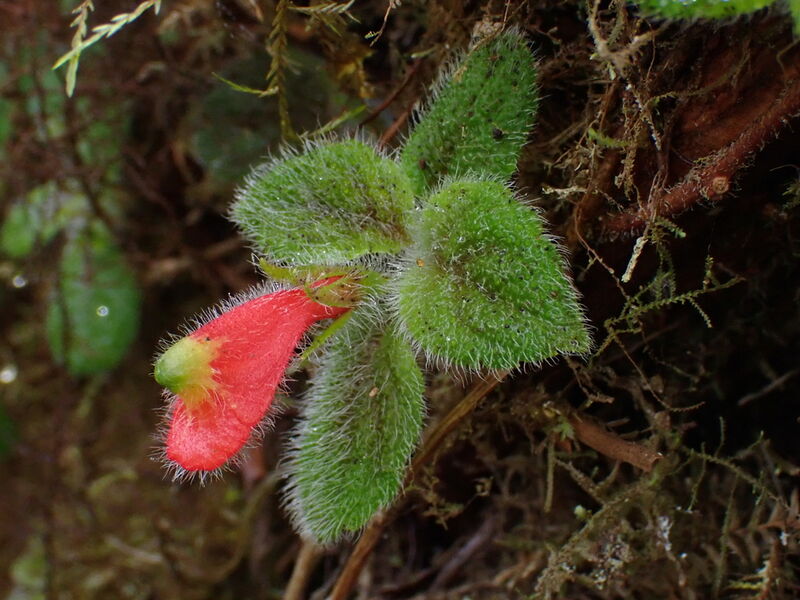
Miniature Pouch Flower
Alloplectus nummularia
Alloplectus nummularia is a rare tropical gesneriad with slender, trailing or climbing stems and remarkably showy red pouched flowers that are built to catch the eye of a passing hummingbird. This is a specialist's plant -- not something you will find at the garden center -- but for gesneriad enthusiasts it is a standout specimen with serious personality. It needs the cool, moist, humid conditions of its forest-floor origins to really perform.
How to grow Miniature Pouch Flower
bright indirect light (3-6 feet
Keep consistently moist but never waterlogged.
60-80%
60-75°F
A chunky, well-aerated, fast-draining epiphytic
Stem cuttings root readily.
The main threats are low
Fun Facts
Alloplectus nummularia has been reclassified so many times it has accumulated at least five accepted synonyms, including Hypocyrta nummularia, Neomortonia nummularia, and Pachycaulos nummularia -- botanists really could not agree on where it belonged.
Toxic to pets
No specific toxicity data is documented for this species. As a member of Gesneriaceae -- a family that generally lacks significant toxins -- it is likely low risk, but no confirmed safety data exists. Keep away from children and pets as a precaution.
Sources
- Pachycaulos nummularia (clog plant) - RHS (opens in new tab)Botanical Garden
- Pachycaulos nummularia - Plants of the World Online, Kew Science (opens in new tab)Botanical Garden
- Alloplectus - Wikipedia (opens in new tab)Reference
- Alloplectus - Wikipedia (opens in new tab)Reference
- Pachycaulos nummularia (clog plant) - RHS (opens in new tab)Reference
- Pachycaulos nummularia - GBIF Backbone Taxonomy (opens in new tab)Reference
- Pachycaulos nummularia - GBIF Backbone Taxonomy (opens in new tab)Reference
- Pachycaulos nummularia - Gesneriad Reference Web (opens in new tab)Reference
- Pachycaulos nummularia - Gesneriad Reference Web (opens in new tab)Reference
- Pachycaulos nummularia - Plants of the World Online, Kew Science (opens in new tab)Reference