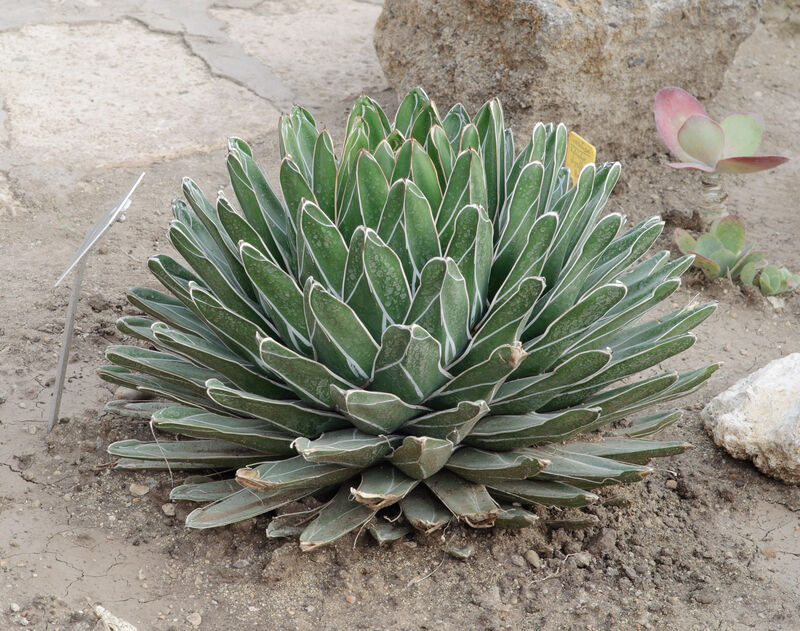
Queen Agave
Agave victoriae-reginae
Agave victoriae-reginae is a slow-growing, compact succulent that forms a tightly symmetrical rosette of dark green leaves etched with white markings -- like someone painted pinstripes on a cactus. It stays small enough for a windowsill or container garden, which makes it the rare agave that can actually live indoors long-term. Just give it maximum light, let it dry out between waterings, and it will largely look after itself for a decade or two before its grand finale bloom.
How to grow Queen Agave
full sun (6 or more
Soak-and-dry method: water thoroughly (water
Low humidity preferred.
Hardy down to 10°F (-12°C),
Well-draining cactus mix with extra
Collect offsets (pups) from the
Spider mites, mealybugs, and the
Fun Facts
The species was named in 1875 by English botanist Thomas Moore specifically in honor of Queen Victoria, who reigned the UK from 1837 to 1901 -- and the plant's slow, dignified growth rate is appropriately regal.
Toxic to pets
Mildly toxic to cats and dogs via saponins and oxalates; can cause vomiting, diarrhea, and skin irritation. The terminal spine is sharp enough to puncture skin -- handle with care.
Sources
- Agave victoriae-reginae - RHS (opens in new tab)Botanical Garden
- Agave victoriae-reginae (Queen Victoria Agave) - World of Succulents (opens in new tab)Reference
- Agave victoriae-reginae (Queen Victoria Agave) - World of Succulents (opens in new tab)Reference
- Agave victoriae-reginae (Queen Victoria Century Plant) - Gardenia.net (opens in new tab)Reference
- Agave victoriae-reginae (Queen Victoria Century Plant) - Gardenia.net (opens in new tab)Reference
- Agave victoriae-reginae - RHS (opens in new tab)Reference
- Queen Victoria Agave 101 - Lazy Gardens (opens in new tab)Reference
- Queen Victoria Agave 101 - Lazy Gardens (opens in new tab)Reference
- Queen Victoria Agave Care: A Complete Grower's Guide - Gardening Know How (opens in new tab)Reference
- Queen Victoria Agave Care: A Complete Grower's Guide - Gardening Know How (opens in new tab)Reference