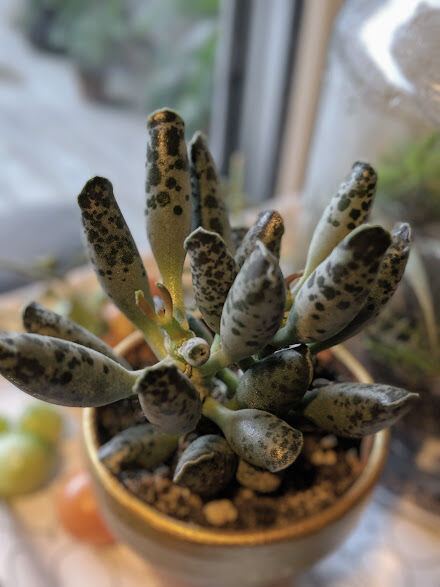
Plover Eggs
Adromischus festivus
Adromischus festivus is a dwarf succulent, up to 7 cm tall, leaves 2.5 to 5 cm long. Form groups of stems.
How to grow Plover Eggs
Bright direct to partial sun.
Follow a soak-and-dry approach.
50%
Prefers 68 to 77°F (20 to 25°C).
50%
Leaf cuttings are the primary
Mealybugs are the most common
Fun Facts
Adromischus festivus is technically classified as a form of Adromischus cooperi, and the name festivus comes from the Latin for 'festive' or 'merry' — a reference to the cheerfully speckled, egg-like appearance of the leaves.
Toxic to pets
The ASPCA does not list Adromischus as toxic. Multiple pet-focused sources classify it as safe for cats and dogs, noting that any ingestion might cause mild stomach upset at most. Some general succulent care sites are more cautious and recommend keeping it out of reach as a precaution. No documented serious toxicity cases exist for this genus.
Sources
- Adromischus festivus - Llifle Encyclopedia of Succulents (opens in new tab)Reference
- Adromischus festivus - Tula House Plant Library (opens in new tab)Reference
- Adromischus festivus (Plover Eggs Plant) - World of Succulents (opens in new tab)Reference
- Adromischus festivus (Plover Eggs Plant) — World of Succulents (opens in new tab)Reference
- Adromischus festivus — Llifle Encyclopedia of Succulents (opens in new tab)Reference
- Adromischus festivus — Tula House Plant Library (opens in new tab)Reference
- How to Care for Adromischus Festivus - Succulent Zone (opens in new tab)Reference
- How to Care for Adromischus Festivus — Succulent Zone (opens in new tab)Reference